Poland's geology is more varied than its generally flat image suggests. The southern edge of the country runs along the Carpathians and Sudeten mountain ranges, both of which expose significant volumes of stone suitable for construction. Further north, the lowlands were shaped by glaciation and the surface material is predominantly glacial drift — fieldstone, cobbles, and boulders deposited by retreating ice sheets.
Knowing what stone is native to a given region is the first step in sourcing material that will age appropriately and match existing structures.
Main Stone Types and Their Regions
Limestone — Holy Cross Mountains (Góry Świętokrzyskie)
The Holy Cross Mountains in central Poland contain some of the country's oldest exposed geology. Devonian and Silurian limestones and quartzites crop out across the range. Limestones from this area have historically been quarried for building material in the surrounding Świętokrzyskie region, and older farm structures and boundary walls in the area frequently use this stone.
Limestone splits reasonably well along bedding planes, making it usable for flat-bedded coursed rubble work. Its weakness is susceptibility to acid rain over long periods — surface pitting becomes visible on exposed masonry after several decades. For restoration work, matching the local limestone type is important; importing a denser or more porous limestone from another region will create differential movement and moisture retention problems.
Sandstone — Lower Silesia and Podkarpacie
Cretaceous sandstone outcrops widely in Lower Silesia (Dolny Śląsk), particularly around the Kłodzko Valley and the Stołowe Mountains. It is a warm brown-red stone, relatively easy to dress, and was used extensively in the region for buildings, churches, and rural walls from the medieval period onward.
In the southeastern Carpathian foothills (Podkarpacie), flysch sandstones and shales are the dominant material. These tend to split into irregular slabs and are less suited to dressed work but functional for rubble walls and field boundaries. They weather to grey-green tones over time.
Sandstone is more permeable than granite and requires more attention to drainage in wall construction. A sandstone wall that retains moisture will suffer from freeze-thaw spalling, particularly at the top courses.
Granite and Gneiss — Lower Silesia
The Sudeten ranges in Lower Silesia (Karkonosze, Sowie Mountains, Bystrzyckie Mountains) expose granites, gneisses, and schists. Granite from this area has been quarried historically and is still extracted commercially. It is hard, durable, and resistant to weathering, but difficult to split without tools or machinery.
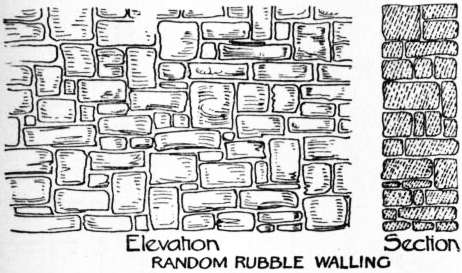
Fieldstone granite — glacially transported cobbles and boulders — is found across large areas of Lower Silesia and Pomerania. This material was used for rural walls and building foundations throughout the region. Its rounded shape makes it unsuitable for dry-stone walling without substantial backing work, but it is effective in mortared rubble construction where the mortar fills the irregular voids.
Schist — Podhale and Beskidy
Metamorphic schists and phyllites in the Podhale and western Carpathian foothills split naturally into flat slabs with smooth cleavage faces. This makes them exceptionally well-suited to dry-stone work. The characteristic Podhale field walls — often running for hundreds of metres across upland meadows — are almost entirely schist construction. The stone requires no dressing in most applications; pieces can be selected from scree or surface outcrops at the right dimensions.
Fieldstone from Glacial Deposits
Across the North Polish Lowlands — from the Pomeranian Lake District through Masovia to Warmia and Mazury — the only building stone available historically was glacial fieldstone. These are stones of mixed lithology (granite, gneiss, quartzite, limestone) transported from Scandinavia and deposited during the Pleistocene ice ages.
Fieldstone walls in this region tend to be mortared, because the rounded shapes are difficult to stack in the dry method. Lime mortar was traditionally used; later constructions often used Portland cement, which has caused problems in some older walls (see the restoration article for more on cement versus lime mortar compatibility).
Quarry Stone vs. Salvaged Material
For repair work on existing walls, salvaged stone from the same structure or from a nearby demolished building is almost always preferable to quarried stone. Salvaged material has been weathered to the same degree as the surrounding wall, will match visually, and typically has the same porosity characteristics — which determines how quickly it takes up and releases moisture.
When salvaged material is unavailable, sourcing from a quarry in the same geological formation as the original structure is the next best option. Polish geological maps are publicly available through the Polish Geological Institute (PIG), which publishes geological maps at 1:50,000 and 1:200,000 scales that identify surface outcrop types.
Legal Considerations
Collecting stone from a field, riverbed, or uncultivated land in Poland without the landowner's permission is not permitted. Stone from registered heritage sites or from sites listed in local archaeological and cultural heritage registers may be subject to additional restrictions under the Act on the Protection and Care of Monuments (Ustawa o ochronie zabytków i opiece nad zabytkami, 2003, as amended).
For commercial quantities, quarrying requires permits under Polish mining and geological law. Small amounts of stone for personal repair work fall in a grey area that varies by municipality; checking with the local gmina office before collecting is advisable.
The Polish Geological Institute maintains an online geological map viewer at pgi.gov.pl that allows identification of surface geology by region. Useful for determining what rock types are native to a specific area before sourcing.